
Look for the helpers
On Friday February 14, Valentine’s Day, 2025, the notices started coming in. Thousands of Americans had lost their jobs.
People working at Centers for Disease Control, the US Department Agriculture, the Department of Transportation, the US Agency for International Development, and more, with apparent disregard for performance or tenure, had been suddenly terminated. It would turn out to be the single biggest month of American job loss in decades.
Dr. Adriana C. Bejarano, a scientist for the National Oceanic and Atmospheric Administration’s Office of Response and Restoration, was among the many impacted.
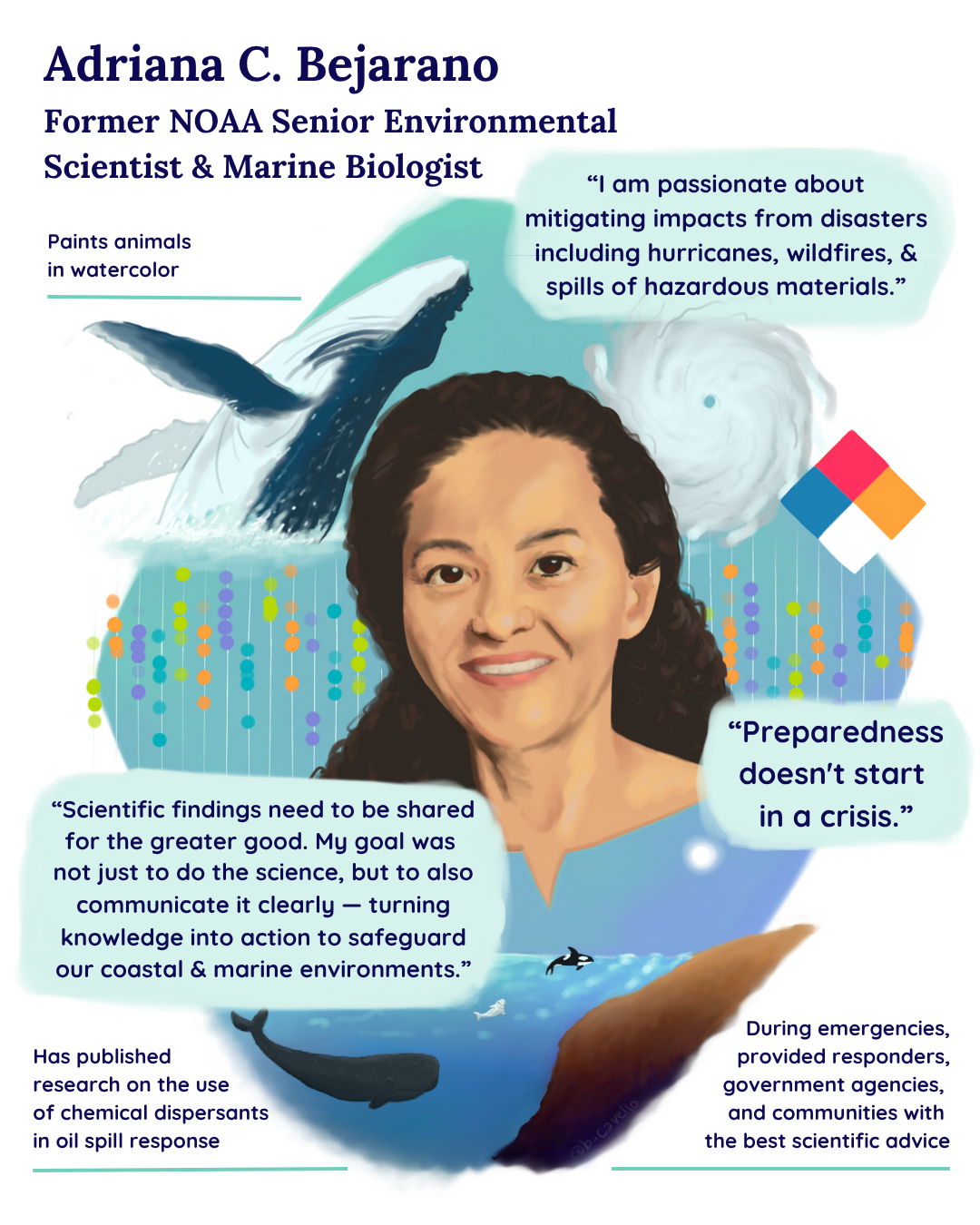
Dr. Bejarano is one of nearly 40 scientists profiled in Silenced Science Stories, a collaborative project organized by Paige Brown Jarreau and Chinmaya Sadangi to amplify the voices of federal scientists and researchers affected by federal budget cuts and grant terminations. The project features illustrations and portraits of scientists with profiles highlighting the importance of their work.
Paige Brown Jarreau began the project from a personal place. A contractor for the US National Institutes of Health, she had borne witness as her colleagues had been unceremoniously dismissed. She reached out to impacted scientists asking if they would be interested in sharing their experiences and coordinated with artists to highlight researchers’ work. I was honored to be able to contribute to this effort as one of over 30 illustrators who lent their talents to the initiative. (That’s my illustration above!)
Now, more than a year later, Paige’s work still sticks with me.
The start of Trump’s second term was a chaotic and disheartening time. I experienced the cuts primarily through social media posts, as connection after connection took to LinkedIn to share the bad news. Comment sections evolved from offering resources and introductions in the hopes of new opportunities to offering commiseration, condolences, and dismay. As a DC resident, it was particularly dramatic. So many friends, neighbors, and colleagues were impacted, and the impacts are still echoing on more than a year later. At the time of this writing, Washington, DC has the highest unemployment rate in the country at 6.2%.
Every day, there were new heartbreaks and new crises. Every day, new grants were being cancelled, offers rescinded, and promises reneged. The 2025 blitz on federal service felt like a DDOS attack—a term for overwhelming a system with so much information that it essentially shuts down.
To many, it may not be obvious how a science communicator or scientific illustrator could do anything to help in that moment. It would have been easy to retreat, to pull away and wait for things to blow over. But Paige found ways to build something powerful—something communal and human and uplifting—using the talents and networks that she had available to her. She created new ways of resisting, honoring, and remembering and brought others along in that process.
Paige was not alone. Some focused on specific departments and agencies, like the team behind USAID Stop-Work, who worked to communicate the impacts both on Americans and people around the world as the Trump Administration’s cuts disrupted critical efforts around disease prevention, food security, counter-terrorism, and more. Others, like The Impact Project, focused on gathering data on cuts to employment, federal grants, and contracts and their impacts to local communities. Many of us began to organize in rapid-response group chats and after-hours video calls, leading to unexpected collaborations, new allies, and dear friendships I cherish to this day.
In moments of crisis, people often invoke Mr. Rogers’ mother’s words: “look for the helpers.” There are sometimes “obvious” helpers, people whose roles and responsibilities situate them to act. Doctors and nurses or lawyers and other experts may be called upon to help us in times of need. But there are other sorts of “first responders,” too. People like Paige, who, in the face of mass disruption and painful loss, take things into their own hands to help, in whatever ways they can, to create a more humanizing world.
In the years ahead, I think we’ll need many more of these helpers. We will need to be these helpers. And I hope that Paige’s example with Silenced Science Stories can serve as a reminder to be creative in how we think about helping. We all have something to offer.
Paige Brown Jarreau is a science communicator based in Baton Rouge, Louisiana. She has over 15 years of experience making science and health information more accessible, relevant, and engaging via creative formats, stakeholder engagement, and collaboration. She’s particularly passionate about innovative media approaches to tell stories about science and the people who make it possible. Paige offers consulting and freelancing services. To get in touch with Paige, check out her website!